
This route assumes permanent Prestige progress, starting resources, and broad building access. It is not a first-playthrough promise. Use the splits as decision gates rather than exact timestamps because artifacts and version balance create variance.
1. Define the category before starting
Record the save state that makes the run possible: starting gold and Mithril, unlocked buildings, retained artifacts, Tier 6 bonuses, and allowed speed settings. Without a fixed baseline, a completion time cannot be compared fairly.
The route optimizes three sources of lost time:
- waiting for enough economy to buy the next damage breakpoint;
- arriving at a boss without the required uptime or burst;
- reaching the final gate while still missing a unique artifact.
2. Opening: activate economy and research immediately
Use starting resources to establish the main early damage engine, the research required to scale it, and the exploration system that begins time-gated artifact rolls. Avoid buying every building simply because it is available.
The observed route opened with Lasers, a small Scientist group, and early exploration. Its purpose was to turn damage into gems while the artifact clock ran in parallel.

Exit check
- Ore does not remain unpaid on the ground.
- The main weapon has a clear next breakpoint.
- Artifact and key collection has already begun.
- No housing slot is occupied by a unit without a route purpose.
3. Early–mid game: buy breakpoints, not comfort
Add Scientists until the next marginal purchase no longer unlocks a meaningful Laser or research gain. Add Priests, Stone Callers, or equivalent support only when they start the Faith or calamity-proof economy needed later.
This is also where a speedrun differs from completion play: a comfortable defensive purchase may be skipped if it does not reduce expected time, while a reliable logistics upgrade is kept because a single stalled delivery line can lose an entire split.
4. Mid game: route the mandatory systems in parallel
Between boss gates, four tasks should progress together:
- deepen the primary damage engine;
- collect keys and scheduled unique rewards;
- establish Faith and underground returns;
- reserve forge resources for missing pool items.
If one task is left until the others finish, it becomes forced waiting later.
5. Pivot when the scaling leader changes
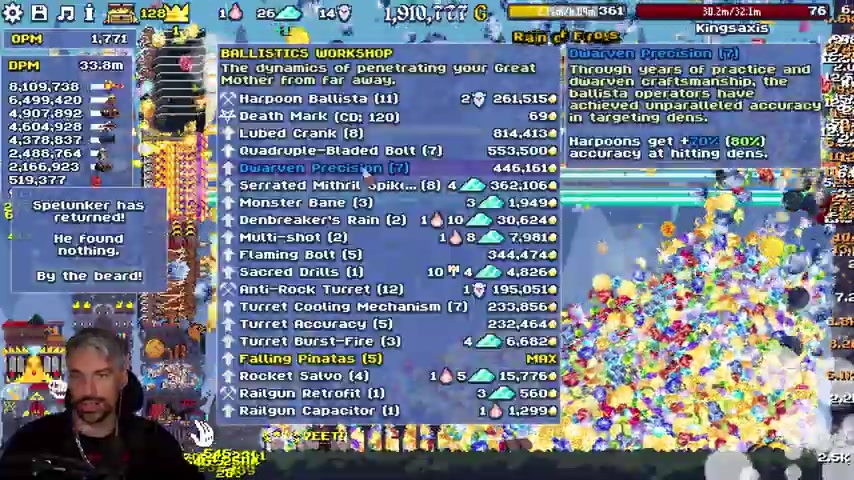
The recorded run used Lasers early, then gained stronger Ballista and Flame Lord scaling later. The exact winner can change, but the pivot rule is stable:
- compare real clear time at 1× speed;
- include the economic value of each unit, not only displayed DPS;
- move new resources to the engine with the best future multiplier;
- keep the old engine if it still generates gems, protects Dens, or supplies another route function.
A pivot is a reallocation of new investment, not necessarily demolition of the old build.
6. Forge and artifact routing
List every endgame item and mark whether it is guaranteed, boss-locked, expedition-based, or Forge-only. Delay mass forging until the route has any refund or efficiency effect it expects, but do not delay so long that the final gate becomes a lottery.
Set a resource floor: Mithril and Souls below that number are reserved for missing mandatory items. Only the surplus can fund optional damage.
7. Final push: remove decisions from the run
By the last phase, the route should be a checklist:
- verify the full artifact set before the gate;
- move all new damage investment to the current scaling leader;
- keep logistics ahead of the larger loot volume;
- use 1× speed for boss validation even if fast-forward is used elsewhere;
- stop buying upgrades whose payback time exceeds the remaining run.
The fastest late-game purchase is often no purchase at all.
8. Review by lost time
After the run, do not only compare total time. Record each delay under one cause:
| Cause | Example | Route fix |
|---|---|---|
| Economy | Waiting for housing or Mithril | Move the income breakpoint earlier |
| Execution | Missed ability or bad positioning | Add a pre-boss checklist |
| Routing | Missing key or Forge item | Start the source earlier or reserve more |
| Build | Damage engine pivoted too late | Define a measurable pivot trigger |
| Version | Values or gates changed | Update the route baseline |
Optimize the largest repeatable loss first. Random artifact variance should be noted separately from route mistakes.
這條路線假設存檔已經擁有一定轉生永久成長、起始資源和廣泛建築權限,不是“新檔三小時通關”的承諾。神器與版本平衡會製造波動,因此各階段應作為決策門檻,而不是精確時間點。
1. 開始前先定義速通類別
記錄本次運行的基礎條件:起始金幣與秘銀、已解鎖建築、保留神器、6 級加成以及允許的遊戲速度。沒有固定基線,不同完成時間無法公平比較。
路線主要優化三種時間損失:
- 等待經濟達到下一個傷害節點;
- 到達首領時缺少在線率或爆發;
- 抵達最終入口時仍缺獨特神器。
2. 開局:立刻啟動經濟與研究
用起始資源建立前期主傷害引擎、支撐它的研究,以及能儘早開始計時型神器判定的探索系統。不要因為建築都已可用,就一次全部購買。
實戰路線以激光炮、小規模科學家和早期探索開局,讓傷害轉化為寶石的同時,神器時鐘也並行運轉。
離開開局階段前檢查
- 地上沒有長期未入賬礦石。
- 主武器有明確的下一升級節點。
- 神器與鑰匙收集已經開始。
- 沒有住房位置被無路線職責的單位佔用。
3. 前中期:購買節點,而不是舒適度
增加科學家,直到下一名單位不再解鎖有意義的激光炮或研究收益。牧師、喚石者等支援單位,也只有在能啟動後續信仰或抗災經濟時才加入。
速通與穩定完成的差異也在這裡體現:不會縮短預期時間的舒適型防禦可以跳過,但可靠物流不能省,因為一次全線停運就可能損失整個分段。
4. 中期:並行推進強制系統
首領節點之間應同時推進四件事:
- 深化主傷害引擎;
- 收集鑰匙與預定獨特獎勵;
- 建立信仰與地下返回;
- 為偉大熔爐限定物品保留資源。
如果等其他三項結束後才啟動其中一項,後期就會變成強制等待。
5. 成長領先者改變時及時轉型
測試路線前期使用激光炮,後期由更強的魚叉弩炮與烈焰領主成長接手。具體單位可能隨版本改變,但轉型規則穩定:
- 在 1× 速度下比較真實清層時間;
- 計算單位的經濟價值,而不只看面板傷害;
- 把新增資源轉向未來倍率更高的引擎;
- 如果舊引擎仍能產寶石、拆巢或提供路線功能,就繼續保留。
轉型是改變新增投資方向,不一定要拆掉舊構築。
6. 偉大熔爐與神器路線
列出所有終局物品,並標記其來源是保證獲得、首領限定、探索產出還是偉大熔爐限定。若路線依賴返還或效率效果,可以等它到手後集中鍛造,但不能晚到讓最終入口完全依賴隨機。
設定資源底線:低於底線的秘銀與山魂專門用於缺失必需品,只有餘額可以投入可選傷害。
7. 最終衝刺:消除臨場決策
最後階段應變成清單:
- 入口前確認完整神器套裝;
- 新增傷害資源全部給當前成長領先者;
- 物流要提前覆蓋不斷增加的掉落量;
- 即使其他階段快進,首領戰驗證仍回到 1×;
- 停止購買回本時間超過剩餘賽程的升級。
後期最快的購買,有時就是不買。
8. 按損失時間覆盤
結束後不要只比較總時間,而應給每段延誤歸因:
| 原因 | 示例 | 路線修正 |
|---|---|---|
| 經濟 | 等待住房或秘銀 | 把收入節點前移 |
| 操作 | 漏技能或站位錯誤 | 增加首領戰前清單 |
| 路線 | 缺鑰匙或偉大熔爐物品 | 更早啟動來源或增加儲備 |
| 構築 | 主引擎轉型太晚 | 定義可測量的轉型觸發條件 |
| 版本 | 數值或入口改變 | 更新路線基線 |
優先優化最大且可重複的損失。神器隨機波動應與路線錯誤分開記錄。