
Completion and speedrunning are different problems. This route favors a stable scaling engine, complete artifact access, and low failure risk. Exact counts are starting points from the observed run; adapt them to your version and artifacts.
1. Know what the final run must accomplish
The completion run has four parallel jobs:
- survive and clear the scheduled boss gates;
- collect the unique items required for endgame access;
- build damage that continues scaling after ordinary upgrades flatten;
- create enough resource throughput for the post-100 gold target.
A build that clears Mountain 100 but cannot accelerate gold production is incomplete. So is an economy build that arrives without the required artifacts.
2. Establish the early income engine
The tested route used Lasers and Scientists as both damage and gem production. The sequence was:
- establish Runner throughput and housing;
- add a small Laser core;
- reach the Scientist breakpoint for gem-related upgrades;
- turn repeated Laser hits into a steady income stream;
- unlock support buildings only when their first upgrade has an immediate purpose.
This engine funds the later Ballista, Faith, underground, and forging systems. If another artifact gives you a stronger early engine, use it—but preserve the goal of damage that also improves income.
3. Unlock scaling before farming its resource
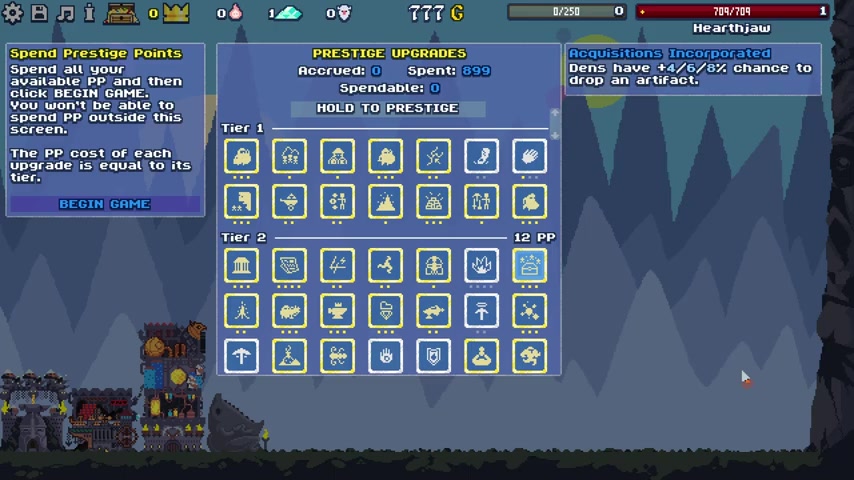
Several endgame bonuses are not retroactive. If a Ballista upgrade gains power from future Den kills, every Den destroyed before unlocking it is a missed stack. The same principle applies to Mapping conversions and repeated Faith rituals.
Before settling into a long farming phase, confirm that the run has already unlocked the upgrade that converts that activity into permanent or cumulative power.
4. Layer three complementary engines
Ballistas: primary progression damage
Use Ballistas for Den coverage and the Den-destruction bonuses available in the route. They provide the reliable damage needed to keep pace with mountain HP.
Lasers: income frequency
Continue raising hit frequency, gem procs, and Scientist support. In the completion build, Lasers are valuable even after another unit leads the DPS chart because they accelerate the gold loop.
Faith and Underground Mapping: long-run multipliers
Priests and related support turn population into repeatable Faith spending. Spelunker returns raise Mapping and feed upgrades that convert exploration into damage. Protect expedition units before relying on this engine.

5. Treat artifact collection as a gate, not a side quest
Track each unique artifact by source: boss, forge, expedition, research, or special event. Reserve resources for the forge only after checking which guaranteed rewards still lie ahead. Forging too early can consume the same Mithril or Souls needed to reach the next guaranteed source.
Use the artifact acquisition guide to open each source early and diagnose a missing Spire item by route.
Before each major checkpoint, verify:
- which unique reward is expected;
- which collection pieces remain missing;
- whether a retention or protection upgrade is needed before Prestige;
- whether the current run can safely delay progression for another expedition return.
6. Transition from progression to the gold loop
Around the final mountains, the priority changes. Mountain damage is no longer the only target; gold per real minute becomes the completion metric.
The observed loop combined:
- frequent Laser hits and gem generation;
- enough Ballista damage to keep high-HP targets moving;
- repeated Faith spending for critical multipliers;
- Mapping returns for another scaling axis;
- Mithril spent on the upgrades with the largest multiplicative effect.
Small percentage upgrades remain valuable late because they multiply an already large base. Choose multipliers that affect the whole loop over flat bonuses that only improve one event.
7. Phase roadmap
| Phase | Main objective | Leave the phase when… |
|---|---|---|
| Opening | Stable logistics and income-producing damage | Ore flows and the first research breakpoints are funded |
| Foundation | Unlock Faith, underground, Forge, and Den scaling | Each long-run activity now feeds a multiplier |
| Collection | Secure boss rewards and missing unique items | The endgame gate checklist is complete |
| Lock-in | Deepen one DPS engine and its support systems | Mountain clears remain comfortably ahead of gates |
| Completion loop | Maximize gold per real minute | The one-billion target is reached |
8. Failure points
- Destroying Dens before unlocking a non-retroactive Den bonus.
- Spending Mithril on small upgrades while a core Forge or boss requirement is pending.
- Dropping Laser investment after it falls behind in DPS, even though it drives income.
- Expanding Spelunkers before protecting them from permanent loss.
- Entering a boss on fast-forward without checking real 1× performance.
- Reaching endgame with an incomplete artifact ledger.
100% 完成與速通是兩個不同問題。這條路線優先保證成長穩定、神器入口完整和低失敗風險。文中的單位規模來自一次實戰,只作為起點;應根據版本與本局神器調整。
1. 明確最終運行的四個任務
完成局需要同時做到:
- 通過預定首領門檻;
- 收齊終局入口需要的獨特物品;
- 建立普通升級放緩後仍能繼續成長的傷害;
- 為 100 層後的金幣目標準備足夠吞吐量。
能過第 100 座山卻無法加速金幣的構築並不完整;經濟很強卻缺少入口神器,同樣無法完成目標。
2. 先建立前期收入引擎
測試路線用激光炮與科學家同時承擔傷害與寶石產出:
- 先穩定搬運工吞吐與住房;
- 建立小規模激光炮核心;
- 到達寶石相關升級所需的科學家節點;
- 把高頻激光炮命中轉化為穩定收入;
- 支援建築只有在第一項升級能立即發揮作用時才解鎖。
這個引擎將供養後續魚叉弩炮、信仰、地下與鍛造系統。如果本局神器提供了更強的早期引擎,可以替換單位,但要保留“傷害同時改善經濟”的目標。
3. 在刷資源之前先解鎖對應倍率
部分終局獎勵不會追溯計算。如果魚叉弩炮升級只從未來拆巢獲得成長,那麼解鎖前摧毀的巢穴都是永久損失。地層測繪轉化與重複信仰儀式也遵循類似邏輯。
開始長時間刷取前,應確認本局已經解鎖了能把這項行為轉化為永久或累計成長的升級。
4. 疊加三個互補引擎
魚叉弩炮:主推進傷害
用魚叉弩炮覆蓋巢穴,並承接路線裡的拆巢成長。它負責讓傷害跟上山體生命。
激光炮:收入頻率
繼續提高攻擊頻率、寶石觸發與科學家支援。即使後期傷害榜首由其他單位佔據,激光炮仍能加速金幣循環。
信仰與地層測繪:長局倍率
牧師相關係統把人口轉為可重複投入的信仰;探險家返回提高地層測繪,並接入探索轉傷害的升級。依賴這條路線前必須先保護探索單位。
5. 把神器收集視為入口,而不是支線
按來源追蹤每件獨特神器:首領、偉大熔爐、探索、研究或特殊事件。投入鍛造前,先確認後續還有哪些保證獎勵。過早鍛造可能消耗本應用來抵達下一個確定來源的秘銀或山魂。
可以配合神器獲取與收集指南,提前啟動各類來源,並按路線排查缺失的世界巨峰神器。
每個大節點前檢查:
- 預計獲得哪件獨特獎勵;
- 收集清單還缺什麼;
- 轉生前是否需要保留或保護升級;
- 是否值得為了下一次探索返回而暫緩推進。
6. 從推進切換到金幣循環
接近最終山體時,目標會改變。山體傷害不再是唯一指標,每個現實分鐘獲得的金幣才是完成度指標。
實戰循環由這些部分組成:
- 高頻激光炮命中與寶石生成;
- 足以推動高血量目標的魚叉弩炮傷害;
- 重複投入信仰獲得暴擊倍率;
- 地層測繪返回提供另一條成長軸;
- 把秘銀投入乘算收益最高的升級。
後期基數很大,小比例升級仍然有價值。優先選擇能放大完整循環的倍率,而不是隻改善一次事件的固定加成。
7. 分階段路線
| 階段 | 主要目標 | 離開階段的條件 |
|---|---|---|
| 開局 | 穩定物流與能產出收入的傷害 | 礦物流動,第一批研究節點能被供養 |
| 基礎 | 解鎖信仰、地下、偉大熔爐與拆巢成長 | 每項長線活動都已接入倍率 |
| 收集 | 取得首領獎勵與缺失獨特物品 | 終局入口清單完整 |
| 成型 | 深化一個傷害引擎及支援系統 | 山體推進持續領先門檻 |
| 完成循環 | 最大化現即時間金幣產量 | 達成 10 億金幣目標 |
8. 常見失敗點
- 在解鎖非追溯的拆巢獎勵前提前清掉大量巢穴。
- 核心鍛造或首領需求尚未滿足,卻把秘銀花在邊緣升級。
- 激光炮掉出傷害榜第一後停止投資,忽略它仍在驅動收入。
- 沒有防損失能力時盲目擴充探險家。
- 快進狀態進入首領戰,卻未檢查真實 1× 表現。
- 抵達終局時神器清單仍不完整。